Succession: the establishment of Melnotte and Dufossée as legitimate shoemaking references in Paris and London in the 19th century (1800-1870)
This study describes the pioneering activities of French shoemak ers Melnotte and Dufossée towards the expansion of their companies and the role of “sucession” to label a shoemaker as legitimate and successful. It is based on the analysis of shoes from both companies and their competitors, newspaper ads and other primary and secondary sources to indicate the companies’ strategies and their development during the 19th century. Ex amples of the companies’ customers are used as a complementary source to indicate the economic strength of these businesses and their typical produc tion. The conclusion is that Melnotte’s London shop worked as a local hub to the “French nouveautés ecosystem” destinated to elite customers who would buy not only shoes but other valued imported articles (umbrellas, corsets, etc). Dufossée benefited from a legitimate scenario with a privileged clientele, stores at strategic addresses and a relevant commercial network, developed during Melnotte’s management. However, companies could also face conflicts of interest and suffer from fights between associates. Finally, alliances via wedding were also relevant for the next generations taking over the family businesses. These elements had an impact on the business’ future trajectory and contributed to the fact that the references are mostly unknown today.
How to quote: SOARES, Cecília Elisabeth Barbosa. Succession: the establishment of Melnotte and Dufossée as legitimate shoemaking references in Paris and London in the 19th century (1800-1870). História Econômica & História de Empresas, vol. 28, no. 3, p.01-72, 2025. https://doi.org/10.29182/hehe.v28i3.1040.
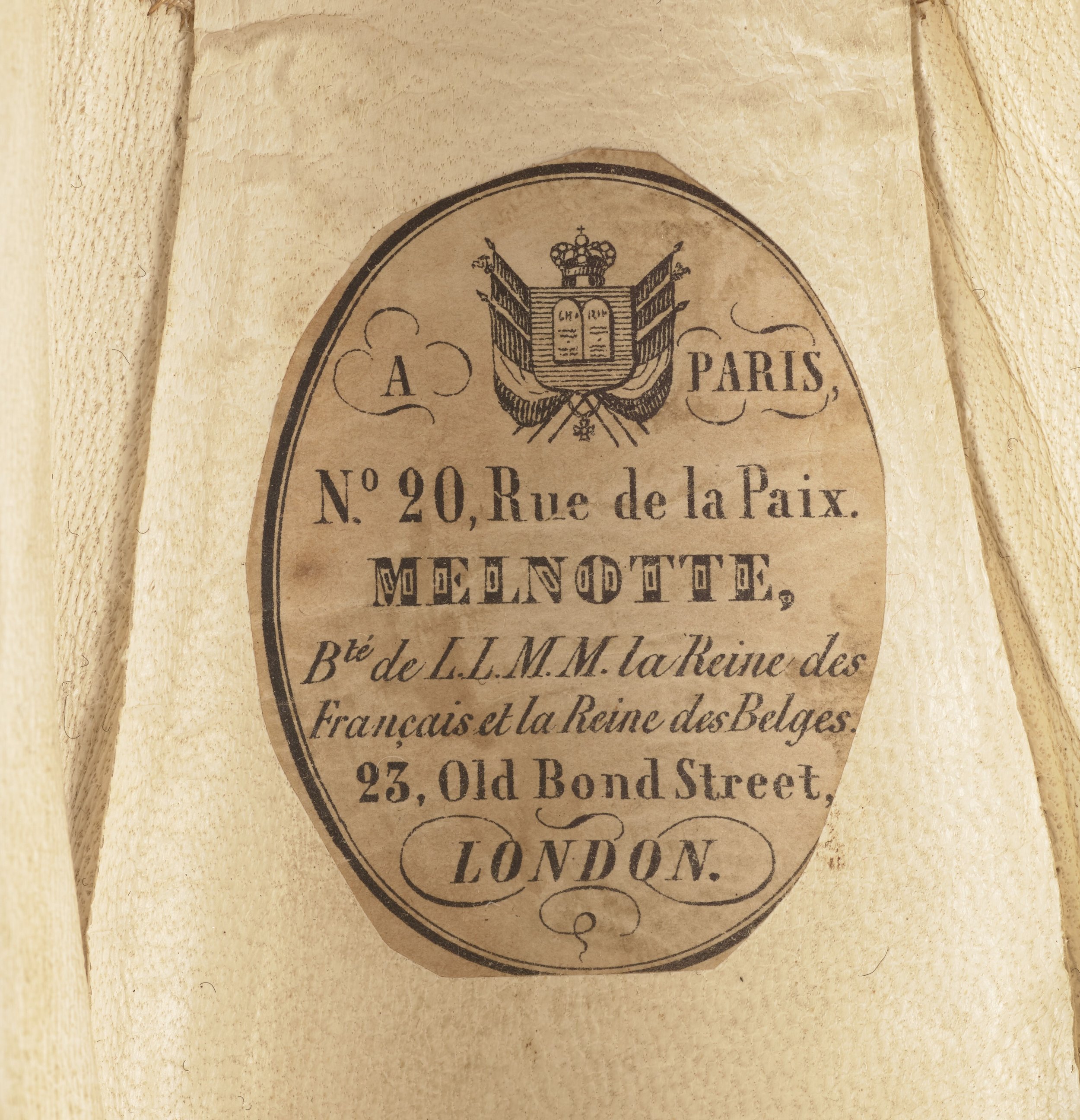
Paper label from the inside of a woman’s slippers by Melnotte. Owned by Priscilla Saxton. 65 x 50 x 240 mm. 1846-1850, France, by Melnotte. Gift of Mrs C Saxton, 1952. CC BY-NC-ND 4.0. Te Papa (PC000069).